Special Relativity (1905)
Einstein's special theory of relativity rests on two postulates: the laws of physics are identical in all inertial (non-accelerating) frames, and the speed of light is constant for all observers regardless of the motion of source or observer.
These simple postulates have profound consequences.
Time Dilation:
A moving clock runs slower than a stationary one. If a clock moves at velocity relative to an observer, it ticks at a rate:
where is the Lorentz factor. At , — the moving clock runs at less than half the rate of the stationary one.
Length Contraction:
Objects in motion appear contracted along the direction of travel:
Mass-Energy Equivalence:
The most famous equation in physics:
More completely, for a moving particle: , where is momentum.
General Relativity (1915)
Special relativity handles inertial frames. General relativity extends this to accelerating frames and gravity. Einstein's key insight was the equivalence principle: there is no local experiment that can distinguish free fall in a gravitational field from inertial motion in empty space.
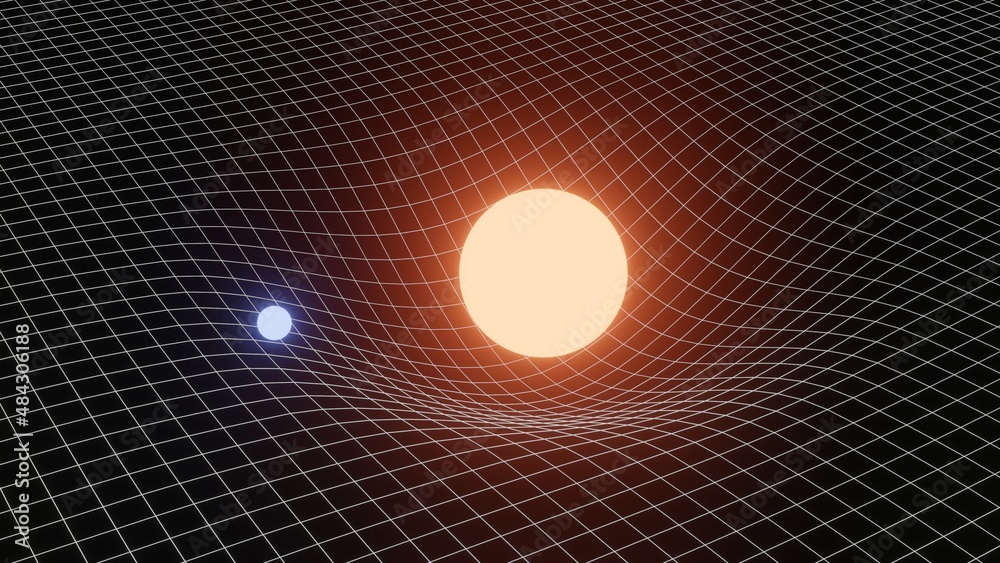
Gravity is not a force — it is the curvature of spacetime caused by mass and energy. The Einstein field equations relate spacetime curvature to the distribution of matter and energy:
Where is the Einstein tensor (encoding curvature), is the metric tensor, is the cosmological constant, and is the stress-energy tensor (encoding matter and energy).
Gravitational Time Dilation:
Clocks in stronger gravitational fields run slower. At height above a massive body of radius :
For small , this approximates to:
GPS: Relativity in Engineering
The Global Positioning System provides the clearest real-world demonstration that relativistic corrections are essential engineering, not abstract theory.
GPS satellites orbit at ~20,200 km altitude, moving at ~3.87 km/s. Two effects operate simultaneously:
Special relativistic effect (time dilation): The satellite's velocity causes its clock to run slower than Earth-surface clocks by approximately microseconds per day.
General relativistic effect (gravitational time dilation): The weaker gravitational field at altitude causes satellite clocks to run faster than surface clocks by approximately microseconds per day.
The net effect is approximately microseconds per day — satellite clocks gain 38 microseconds per day relative to Earth clocks. Since GPS position accuracy depends on time measurements accurate to nanoseconds, this ~38,000 nanosecond daily error would accumulate to position errors of roughly 10 km per day if uncorrected.
GPS satellite clocks are therefore pre-compensated: they are set to tick slightly slower before launch, so that in orbit they run at the correct rate from Earth's perspective. Every GPS fix you take is a practical application of both special and general relativity.