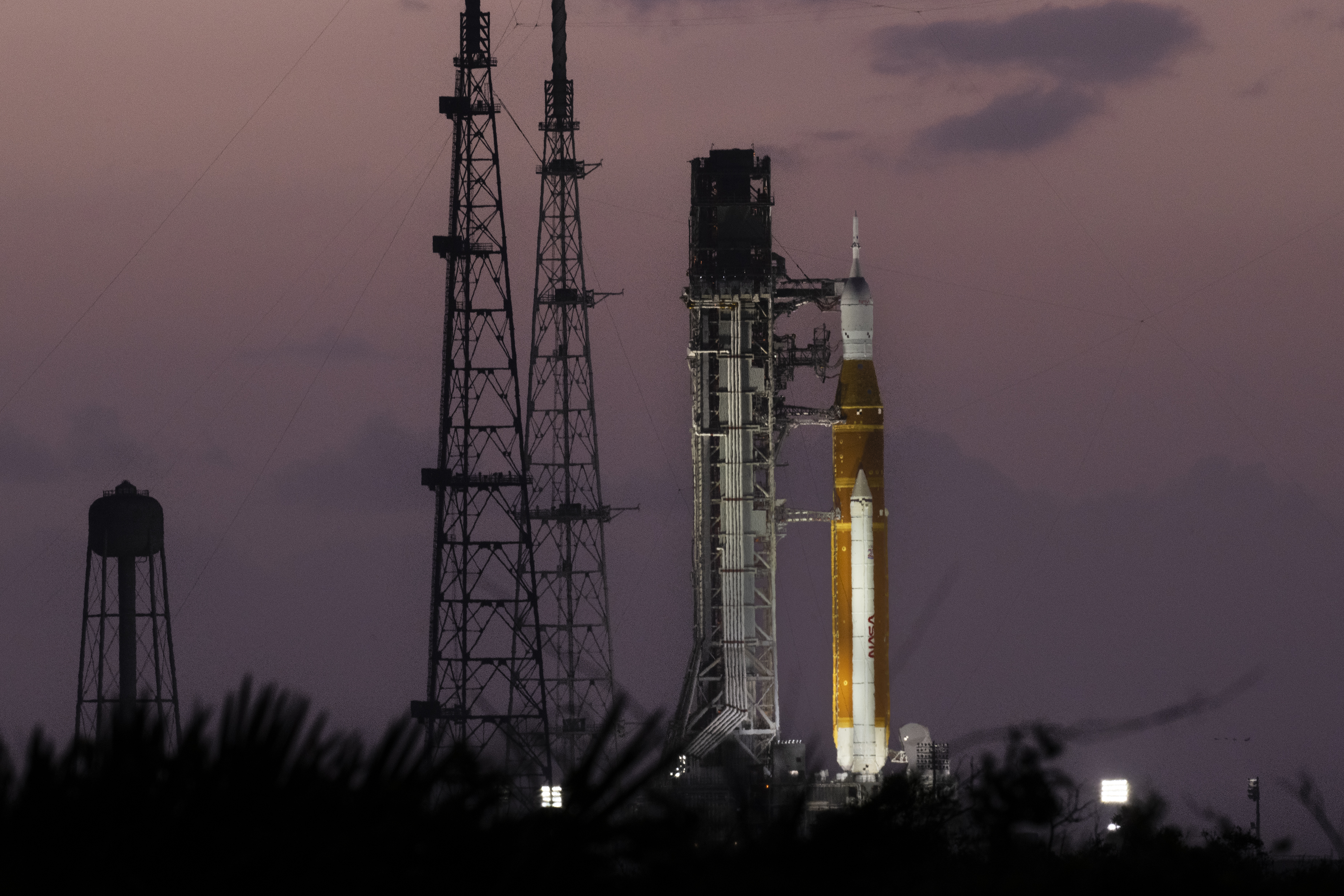
Half a century after Apollo 17 left the last human bootprints in lunar dust, Artemis II is preparing to carry four astronauts around the Moon. It will be the first crewed flight of NASA's Artemis program — and a full dress rehearsal for the landing that follows.
What Artemis II will do
The mission is a free-return trip: the Orion spacecraft loops behind the Moon and uses lunar gravity to slingshot home, never entering orbit. It validates every crewed system before Artemis III attempts a south-pole landing.
- Launch aboard the Space Launch System (SLS)
- A roughly 10-day flight around the Moon and back
- First crew to leave low-Earth orbit since 1972
Readiness checklist
- Orion crew module integrated
- SLS core stage stacked
- Crewed launch — targeted for 2026
Info
A free-return trajectory is shaped so that, even with no engine burns, the Moon's gravity sends the spacecraft back toward Earth.
Caution
All dates are targets, not guarantees — crewed schedules slip as hardware testing demands.
Milestone
Artemis I already flew Orion around the Moon uncrewed in 2022, clearing the way for a crew.
The crew
We are going back to the Moon — and this time, to stay. NASA Administrator
| Role | Astronaut | Agency |
|---|---|---|
| Commander | Reid Wiseman | NASA |
| Pilot | Victor Glover | NASA |
| Mission Specialist | Christina Koch | NASA |
| Mission Specialist | Jeremy Hansen | CSA |
How the trajectory works
The circular-orbit velocity scales with the gravitational parameter GM and orbital radius r:
v = √(GM / r)
Engineers write the escape condition as E = ½mv2 − GMm/r ≥ 0, with the reference altitude denoted r0.
def specific_energy(v, r, GM):
    # positive energy => escape trajectory
    return 0.5 * v**2 - GM / r
Timeline
- 1972Apollo 17 — the last crewed lunar mission
- 2022Artemis I — uncrewed Orion flight around the Moon
- 2026Artemis II — first crewed Artemis flight
- 2027+Artemis III — crewed south-pole landing
Common questions
Will Artemis II land on the Moon?
No. Artemis II is a crewed fly-by; the landing is Artemis III.
Who are NASA's international partners?
The Canadian Space Agency provides an astronaut and robotics; ESA builds Orion's service module.
Formatting sampler (for QA): bold, italic, underline, strikethrough, highlight, inline code, keyboard Ctrl+K, an external source at NASA.gov, superscript 103, and subscript H2O.
References
- NASA, Artemis II Mission Overview, nasa.gov (2026).
- Canadian Space Agency, Jeremy Hansen — Artemis II (2026).